


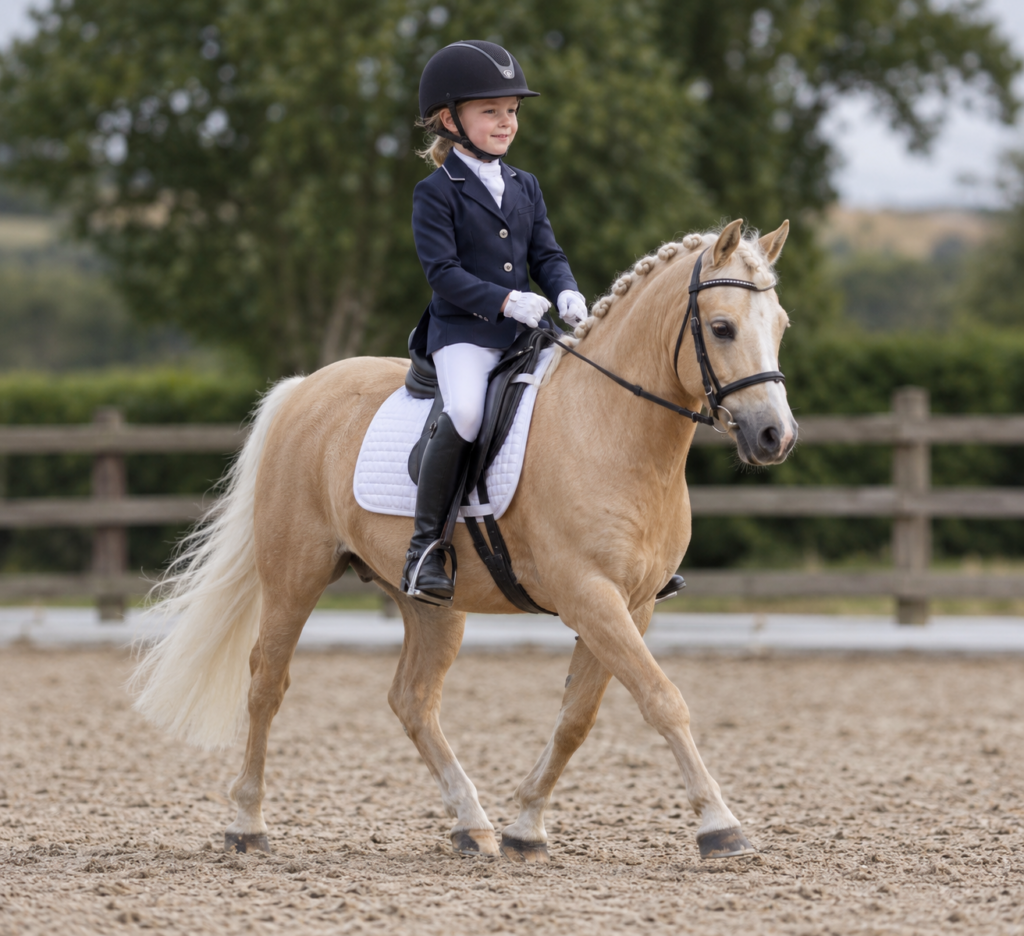
Having a pony of their own is a dream for many children. Instead of riding a riding-school pony during a weekly lesson, they can care for their own pony, train together and perhaps enter competitions.
For parents, buying a pony is often more complicated. Which pony suits your child? How old should a child’s pony be? What height is appropriate? How important is competition experience? And, perhaps most importantly, how can you tell whether a pony is reliable?
Buying a pony for a child involves different considerations from an experienced adult buying a horse for themselves. This article explores the main points to consider.
The right pony is about the right partnership
What level has the pony competed at? How well does it jump? How much potential does it have? Does it have competition points or impressive results?
These can all be useful details, but the partnership between child and pony comes first.
A very talented pony may be wonderful for one child and completely unsuitable for another. The aim is to find a pony your child can ride safely, independently and happily, rather than simply the most accomplished pony within your budget.
Be honest about your child’s ability
Parents understandably focus on what their child can already do. When buying a pony, it is just as important to consider what they still find difficult.
Can your child ride a pony independently when it does not do everything automatically? Can they respond appropriately when a pony spooks or becomes tense? Can they tack up, mount and lead a pony to the arena themselves?
Perhaps the most important question is what happens when things do not go to plan.
A pony that looks straightforward with a professional or very experienced rider may feel quite different to a child. Consider the whole picture, rather than comparing the pony’s level only with your child’s competition level.
An experienced pony can be invaluable
Families sometimes look for a young pony as a first pony, attracted by the idea that child and pony can develop together. However, pairing two inexperienced partners is not always the easiest combination.
A pony that has already experienced competitions, hacking, unfamiliar venues, travelling in a trailer and a range of everyday situations can teach a child a great deal.
An experienced pony often understands what is expected, allowing the child to concentrate more on their own riding. For a first pony in particular, a good schoolmaster can be more valuable than a younger pony with considerable potential.
Avoid buying too far ahead of your child’s needs
Children grow, so it makes sense to think ahead. However, a pony that is too big may leave a child feeling less confident and in control. A pony they can enjoy riding now may bring more pleasure than one that will only fit them properly in two years’ time.
This applies to ability as well as height. A pony with plenty of scope or potential might seem a sensible choice for the future, but that offers little benefit if your child feels nervous riding it today.
What height of pony suits my child?
The right height depends on more than your child’s height alone. The pony’s build also matters: a broad pony can feel much bigger than a narrow pony of the same height. Your child’s leg length, build and ability make a difference too.
In the Netherlands, ponies are placed in competition categories according to their height. A category does not automatically tell you whether a pony is physically suitable for a particular child. See the KNHS guidance on pony measuring for the Dutch categories.
During a trial ride, look at the partnership as a whole. Is your child in proportion to the pony? Can they use their legs effectively? Do they feel confident, and can they influence the pony sufficiently?
That tells you more than the measurement recorded in the pony’s passport alone.
Temperament matters more than colour
A palomino, buckskin, coloured or striking black pony may immediately catch your eye. Colour should never take priority over temperament when buying a child’s pony.
Consider which qualities are essential. Does the pony need to stand quietly while being tacked up? Can your child bring it in from the field independently? Does it stand still for mounting? Is it good in traffic? Can it leave the yard alone? How does it react to other horses in the arena?
These are important qualities in a child’s pony. An attractive pony is lovely, but a pony you feel comfortable watching your child handle and ride is worth far more.
What does “good” actually mean?
Adverts for children’s ponies often describe them as “good”, but this is not an objective measure.
A seller might use the word because a pony never bucks or rears. A parent might understand it to mean that a ten-year-old can bring the pony in from the field, tack it up and ride independently.
Always ask follow-up questions. What does the pony do when it spooks? How does it behave at unfamiliar venues? Can it be ridden normally after a few days off? How does it respond if a child gives an overly strong aid?
The more specific your questions, the easier it is to understand what the seller means.
Watch what happens before the trial ride
A trial ride effectively begins before your child gets into the saddle. Pay attention from the moment you arrive.
Is the pony already tacked up? Has it already been ridden? Does it need lunging first? How does it behave during grooming and tacking up? Does it stand quietly for mounting?
If possible, ask to take part in some of these tasks. A child’s pony needs to be suitable for everyday life, as well as for thirty minutes of riding in an arena.
Let your child do as much as possible
Parents, instructors and sellers naturally want to help at a viewing. Nevertheless, it is valuable to see how much your child can do independently.
Where it is safe and with appropriate supervision, let your child groom, tack up, lead the pony to the arena and mount themselves.
During the ride, notice what happens when the seller or instructor gives fewer instructions. You are buying the pony for the times when the seller will no longer be standing beside you.
Pay attention to your child’s reaction
A trial ride can look excellent from the sidelines while the child feels uncomfortable. That is important information.
Afterwards, ask how the pony felt, as well as whether your child liked it. Did they feel safe? Was it easy to steer? Did it feel fast? Was there a moment when they felt nervous? Would they feel confident riding it independently tomorrow?
Children sometimes want a pony so much that they quickly say everything went well. Consider both what you observed during the ride and what your child tells you.
Competition results do not tell the whole story
If you are looking for a competition pony, results are relevant: they show the level at which the pony has competed. They do not automatically reveal how easy it is to ride.
A pony may have been highly successful with an experienced rider without being suitable for a less experienced child. Equally, a pony with modest results may be an excellent schoolmaster.
Ask who achieved those results with the pony. How old and experienced was the previous rider? How long were they a partnership? Was the pony also regularly ridden by an adult or professional, or was it trained by a child?
These questions provide much more context.
Consider the pony’s daily care and routine
A pony needs to suit your family’s circumstances as well as your child.
Will it live at a livery yard? Is sufficient guidance available? Can your child get to the yard independently? Who will ride the pony when your child is ill or away on holiday?
The pony’s own needs matter too. Can it comfortably have a few days off riding? Does it need plenty of exercise? Can it be turned out in a group? How does it behave with the farrier and vet, during clipping and when travelling?
These details may seem secondary when an advert has caught your imagination, but they become part of everyday life after the purchase.
Budget for more than the purchase price
Most families set a purchase budget when looking for a pony. Remember that the purchase price is only part of the cost.
Allow for livery, farrier visits, veterinary care, feed, lessons, insurance, a saddle and other equipment, transport and, where relevant, competitions. Buying costs may also include a pre-purchase veterinary examination and transport home.
Decide both how much you can spend on the pony and how much you can afford each month for its ongoing care.
Would you like a clearer picture of ongoing costs? Read our article What does a horse cost per month?
Discuss a pre-purchase veterinary examination
Once you have found a pony that seems suitable, consider a pre-purchase examination by a vet.
The appropriate examination depends on factors including the pony’s age, purchase price and intended use. Its individual health and the work you plan to do are important to the assessment. Age alone does not determine suitability: ask the vet to interpret any findings in the context of your plans.
Discuss which examination is appropriate for your circumstances. The KNMvD information on veterinary examination reports provides further background in Dutch.
Create a search profile before browsing adverts
Before you start looking, write down what your family needs. Include:
- Rider: your child’s age, height and ability.
- Purpose: leisure riding, dressage, jumping, eventing or all-round activities.
- Pony’s experience: what should it already be familiar with?
- Temperament: which qualities are essential?
- Age: your preferred age range.
- Height: your preference, with a realistic margin.
- Training: current schooling and, where relevant, competition level.
- Budget: the maximum purchase price and allowance for additional costs.
- Must-haves: the points you will not compromise on.
- Preferences: qualities that would be nice but are not essential.
This helps prevent each appealing advert from changing your idea of what you need.
The right child’s pony does not have to be perfect
No pony is completely predictable, behaves exactly the same every day or suits every rider. Even a reliable pony can spook, have an off day or test boundaries.
You are looking for a pony whose temperament, training and behaviour are within your child’s capabilities, rather than one that never needs guidance.
A pony that tolerates a child’s mistakes without every small error having major consequences gives that child room to learn.
Choose confidence and enjoyment
When buying a pony for a child, it is tempting to focus on the future. How far could they progress? Does the pony have enough ability? Could it compete at a higher level later?
Remember why most children started riding: because they love ponies.
The right pony can help a child develop confidence and responsibility while enjoying their riding. It may not be the youngest, most spectacular or most talented pony you see.
But if your child looks forward to going to the yard and feels safe in the saddle, you may have found something much more valuable.
Help with buying a pony
Finding a suitable pony for a child can be challenging. Adverts only tell part of the story, and parents may find it difficult to judge whether a pony truly matches their child’s ability and wishes.
At RSP Equi Select, I can help with different stages of the search, from creating realistic search criteria and reviewing adverts and videos to advice on trial rides, viewings, negotiations and the pre-purchase examination. You can also read Which horse is right for me? for more advice on finding a suitable partnership.
The aim is to find the right pony for your child, rather than to finish the search as quickly as possible.
Would you like support with finding and buying a pony? Contact RSP Equi Select to learn more about purchase guidance.